Runner’s Knee Symptoms in High School Athletes: What Parents and Teens Should Watch For
Common runner’s knee symptoms in teens include a dull ache around or behind the kneecap that gets worse on stairs, when squatting, kneeling, running or jumping, or after sitting with the knees bent for a long time. Some teens also notice grinding or popping, or mild swelling after practice. If your high school athlete has front-of-knee pain that keeps coming back, it’s worth getting it evaluated, because only a physical therapist or physician who examines your teen can tell what’s really going on.
This guide comes from the team at Desert Edge Physical Therapy on Lake Pleasant Parkway in Peoria. Our Doctors of Physical Therapy work one-on-one with athletes and families from Peoria, Vistancia, Glendale and the Sun City area. Below you’ll find what to watch for, how runner’s knee differs from other teen knee problems, which signs need a doctor right away, and a simple rule for deciding what to do next.
What Is Runner’s Knee? (Patellofemoral Pain, in Plain Language)
“Runner’s knee” is the everyday name for patellofemoral pain. That’s pain at the front of the knee, where the kneecap (patella) glides over the thigh bone (femur). Every time your teen bends and straightens the knee, that joint is working. When it gets irritated, it can ache with everyday movements as well as with sports.
There usually isn’t one single cause. Training load, strength around the hips and thighs, how someone runs or lands, and recent changes in activity can all play a part, and the mix is different for every athlete.
Think of the body as a vehicle that needs a tune-up. A car that pulls to one side still drives, but something in the system needs attention, and a good mechanic checks more than one part before adjusting anything. A sore knee works the same way: the spot that hurts isn’t always where the problem starts. That’s why a thorough evaluation looks at the whole picture.
Despite the name, runner’s knee isn’t only a runner’s problem. It’s one of several possible reasons for knee pain in high school athletes.
What Are the Most Common Runner’s Knee Symptoms in Teen Athletes?
<!– OPTIONAL PROPOSED image block, not inserted. Pending client confirmation of asset ownership, clinical approval of wording, and media-library upload: runners-knee-symptoms-checklist.png (1200×670), full-width, responsive. Alt text: “Checklist of five common runner’s knee symptoms parents and teens can watch for”. –>
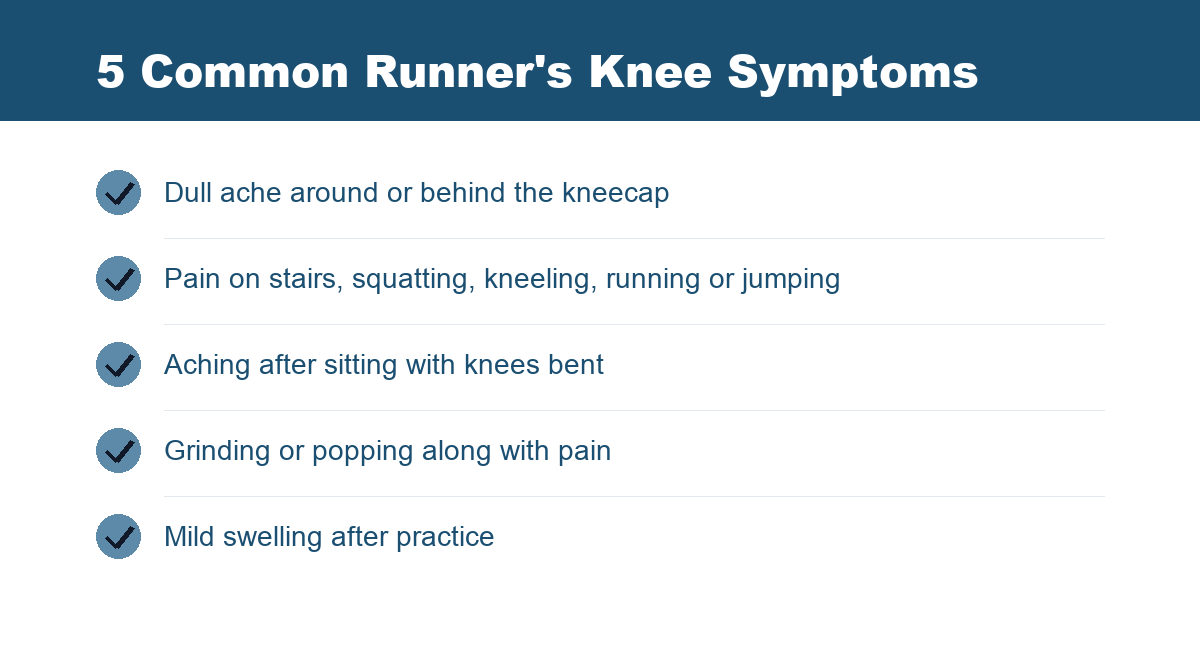
Here’s a quick checklist for parents and teens:
- Dull ache around or behind the kneecap. Teens often rub the whole front of the knee rather than pointing to one spot.
- Pain on stairs, or when squatting, kneeling, running or jumping. Going down stairs is a frequent complaint.
- The “movie theater sign.” The knee aches after sitting with the knees bent for a while, like a long bus ride to an away game, a long class or a movie.
- Grinding or popping under the kneecap. Noise without pain is often harmless. Noise with pain is worth mentioning to a clinician.
- Mild swelling after practice. Swelling that comes on quickly or is more than mild belongs with the red flags below.
You don’t need to wait for several of these to show up. If even one keeps coming back, or your teen is changing how they move because of it, that’s a fair reason to get it checked.
Teens don’t always speak up mid-season, so watch for quieter clues too: favoring one leg on stairs, skipping squats in warm-ups, or icing a knee “just because.” These symptoms can overlap with other conditions, so treat the checklist as a reason to ask questions, not as an answer.
Why Do High School Athletes Get Front-of-Knee Pain?
Teen athletes often have a few things going on at once that can make the front of the knee work harder.
Growth spurts. During fast growth, bones can lengthen ahead of the muscles and tendons around them. For a while, a teen may feel tighter or less coordinated, and may handle training differently than they did last year.
Jumping back in after summer. Moving from a lighter summer into full fall practices for cross-country, football and other sports can mean a sudden jump in miles, sprints and conditioning.
Training in the Arizona heat. Many teams practice early in the morning to beat the heat. Ask your teen what changed when practices started: the time of day, the surfaces they train on, or how much running they do each week. Write down anything that changed. It’s useful information to bring to an evaluation.
Not just runners. Soccer, basketball and volleyball involve lots of jumping, landing, cutting and deep knee bends. Overlapping club and school seasons can leave little recovery time.
If this sounds like your house, you don’t have to sort it out alone. A free 20-minute discovery session is an easy, no-pressure way to talk it through with our team.
Runner’s Knee vs. Other Teen Knee Problems: How Do They Compare?
Several teen knee problems can look alike from the sidelines. Here’s a simple guide to where pain usually shows up and what tends to bring it on:
| Condition | Where it usually hurts | Typical trigger |
|---|---|---|
| Runner’s knee (patellofemoral pain) | Around or behind the kneecap | Stairs, squats, running, sitting with knees bent |
| Jumper’s knee (patellar tendinopathy) | Just below the kneecap, on the tendon | Repeated jumping and landing |
| Osgood-Schlatter | Tender bump below the kneecap, at the top of the shin | Running and jumping during growth spurts |
| IT band syndrome | Outside of the knee | Repetitive running, especially longer runs |
This table is a starting point for a conversation, not a diagnosis. Knee pain can come from more than one source, and a clinician who examines your teen should make the diagnosis. That’s what a comprehensive evaluation is for.
Red Flags: When Does Knee Pain Need a Doctor Right Away?
<!– OPTIONAL PROPOSED image block, not inserted. Pending client confirmation of asset ownership, clinical approval of wording, and media-library upload: knee-red-flags-checklist.png (1200×842), full-width, responsive. Alt text: “Checklist of seven red-flag knee symptoms that call for prompt medical attention”. –>
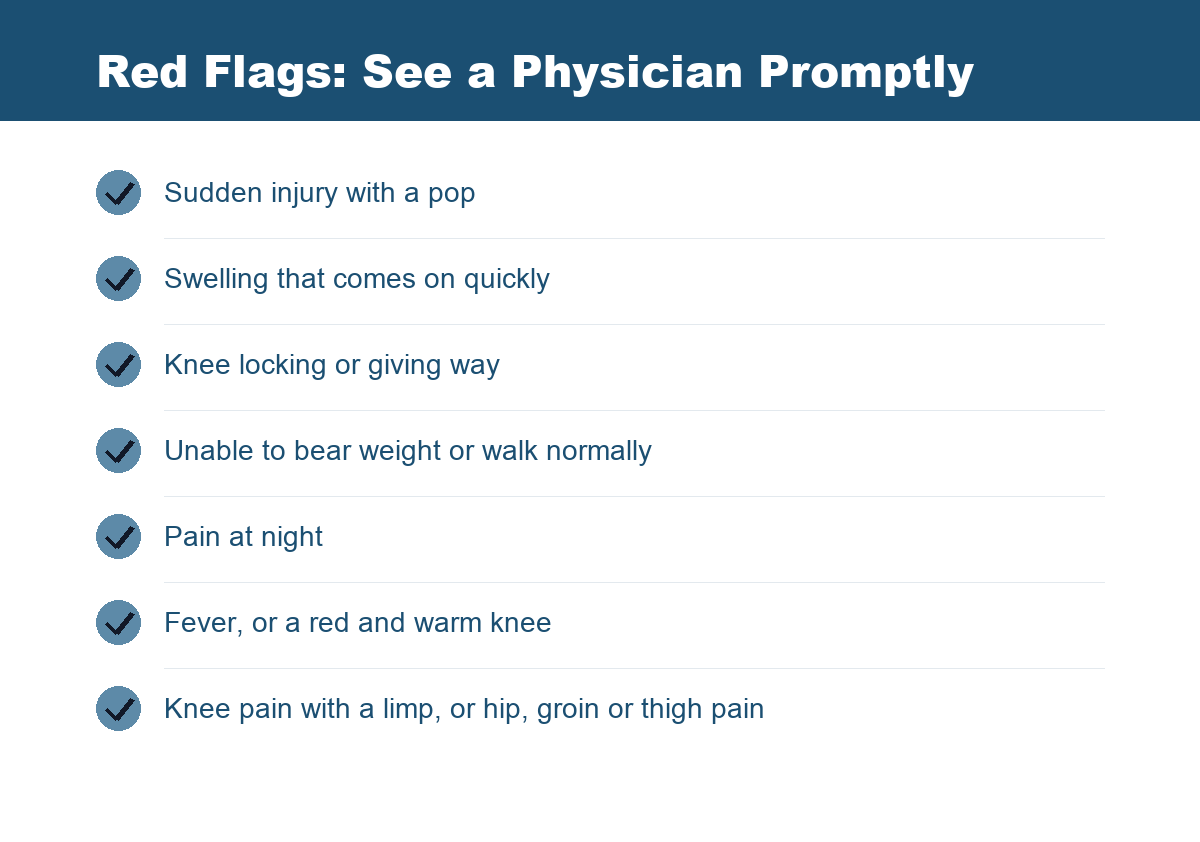
Some signs point to something other than gradual front-of-knee pain. If you notice any of these, have your teen see a physician promptly, rather than waiting it out or starting with physical therapy:
- A sudden injury with a pop, such as during a cut, a landing or a tackle
- Swelling that comes on quickly
- The knee locking (getting stuck) or giving way
- Being unable to bear weight or walk normally
- Pain at night
- Fever, or a knee that’s red and warm
- Knee pain with a limp, or with hip, groin or thigh pain
That last one matters for teens. Some hip problems in growing kids can be felt as knee pain, so a teen with a limp and knee pain needs a physician to check the hip, not just the knee. When in doubt, get it checked.
What Can Teens Do Now Without Losing the Whole Season?
Here’s a simple decision rule for parents:
- Any red flag above: see a physician promptly.
- No red flags, but front-of-knee pain keeps coming back or changes how your teen moves: book an evaluation with a physical therapist or physician.
- Not sure which applies? Call and talk it through. A free phone consultation is made for exactly this.
While you arrange an evaluation, these general steps may help. Whether your teen should keep practicing, modify their training or rest is a decision for a clinician who has examined them, so treat this as a starting point, not a plan.
- Don’t play through sharp pain. Pain that builds during activity, or that changes how your teen runs or lands, is a signal to stop and get checked.
- Keep the coach in the loop. Let them know your teen is getting the knee evaluated, then follow the clinician’s guidance on practice.
- Break up long sitting. On bus rides and in class, straightening the legs or standing when allowed may ease the bent-knee ache.
- Check the shoes. Bring well-worn athletic shoes to the evaluation.
- Keep notes. Track when it hurts, what brings it on and any recent training changes. This helps your clinician.
How Does Physical Therapy Help Young Athletes Get Back to Their Sport?
At Desert Edge Physical Therapy, we start with a comprehensive evaluation, and we don’t rush it. We ask your teen about their sport, schedule and goals. We watch how they move, such as squatting, stepping down and landing, and we often look above and below the knee at the hips, thighs and feet.
If PT is a good fit, care is one-on-one, hands-on and individualized. Depending on the evaluation, a plan may include:
- Hip and quad strengthening
- Running and landing mechanics
- Load management, meaning how much to do and how to build back up
- Footwear and training-surface guidance
The clinic is owned and operated by Mike King, PT, DPT, OCS (Orthopedic Certified Specialist), who has helped people recover from injury since 2008. You can meet Mike and our team. Our team includes Doctors of Physical Therapy, and Spanish is spoken, so the whole family can be part of the conversation.
Every athlete is different, so we don’t promise results or timelines. Our goal is to help your teen understand their knee and move better. You can browse all of our physical therapy services. And don’t take it from us: see what our patients say.
This article is for education, not a diagnosis. Knee pain has many causes. Please see a physician or physical therapist for an evaluation, and seek medical care right away for any red-flag symptoms.
Frequently Asked Questions
Can a teenager really get runner’s knee?
Yes. Runner’s knee in teenagers can show up during growth spurts and when training ramps up, in runners and in athletes who play soccer, basketball, volleyball and football. A clinician should confirm the cause of any knee pain.
Should my teen keep playing if their knee hurts?
That’s a decision for a clinician who has examined your teen. Sharp pain, pain that gets worse during activity, or any red-flag sign means stop and get evaluated. Red flags need a physician promptly.
Is grinding or popping in the knee a bad sign?
Knee noise without pain is often harmless. Grinding or popping along with pain, swelling or the knee giving way should be checked by a clinician.
Do we need a doctor’s referral to see a physical therapist?
It can depend on your situation and your insurance. Desert Edge accepts insurance, so call our team at 623-334-8767 or contact our team, and we’ll walk you through your plan. You can also ask about cost and availability.
How long does runner’s knee take to get better?
It varies from athlete to athlete, so we don’t give one-size-fits-all timelines. A thorough evaluation helps set a realistic plan around your teen’s sport and schedule.
Wondering whether that nagging knee ache is worth a closer look? Book a free 20-minute discovery session or call us at 623-334-8767. We’ll listen, take our time, and work with you on a plan aimed at getting your athlete back to the sport they love.
